Planning Your Twin Registry? Here’s What You Really Need Two Of
Designing a nursery for twins goes hand in hand with building your baby registry. But here’s something many expecting parents don’t realize you don’t need two of everything!
Some essentials, like safe sleep spaces and car seats, are needed for each baby. Other items, such as a changing station, can be shared.
Before purchasing duplicate baby gear, explore our Twin Baby Registry Guide to discover practical registry ideas and make more confident shopping decisions.
For an organized approach, our Twin Triage Toolkit on Etsy includes a Twin Registry Triage Matrix to help you sort what to double up on, what to share, and what can wait.
Designing a nursery for twins goes hand in hand with building your baby registry. But here’s something many expecting parents don’t realize you don’t need two of everything!
Some essentials, like safe sleep spaces and car seats, are needed for each baby. Other items, such as a changing station, can be shared.
Before purchasing duplicate baby gear, explore our Twin Baby Registry Guide to discover practical registry ideas and make more confident shopping decisions.
For an organized approach, our Twin Triage Toolkit on Etsy includes a Twin Registry Triage Matrix to help you sort what to double up on, what to share, and what can wait.
1. Start With Two Safe Sleep Spaces
Before choosing a nursery theme or shopping for furniture, prioritize where your babies will sleep.
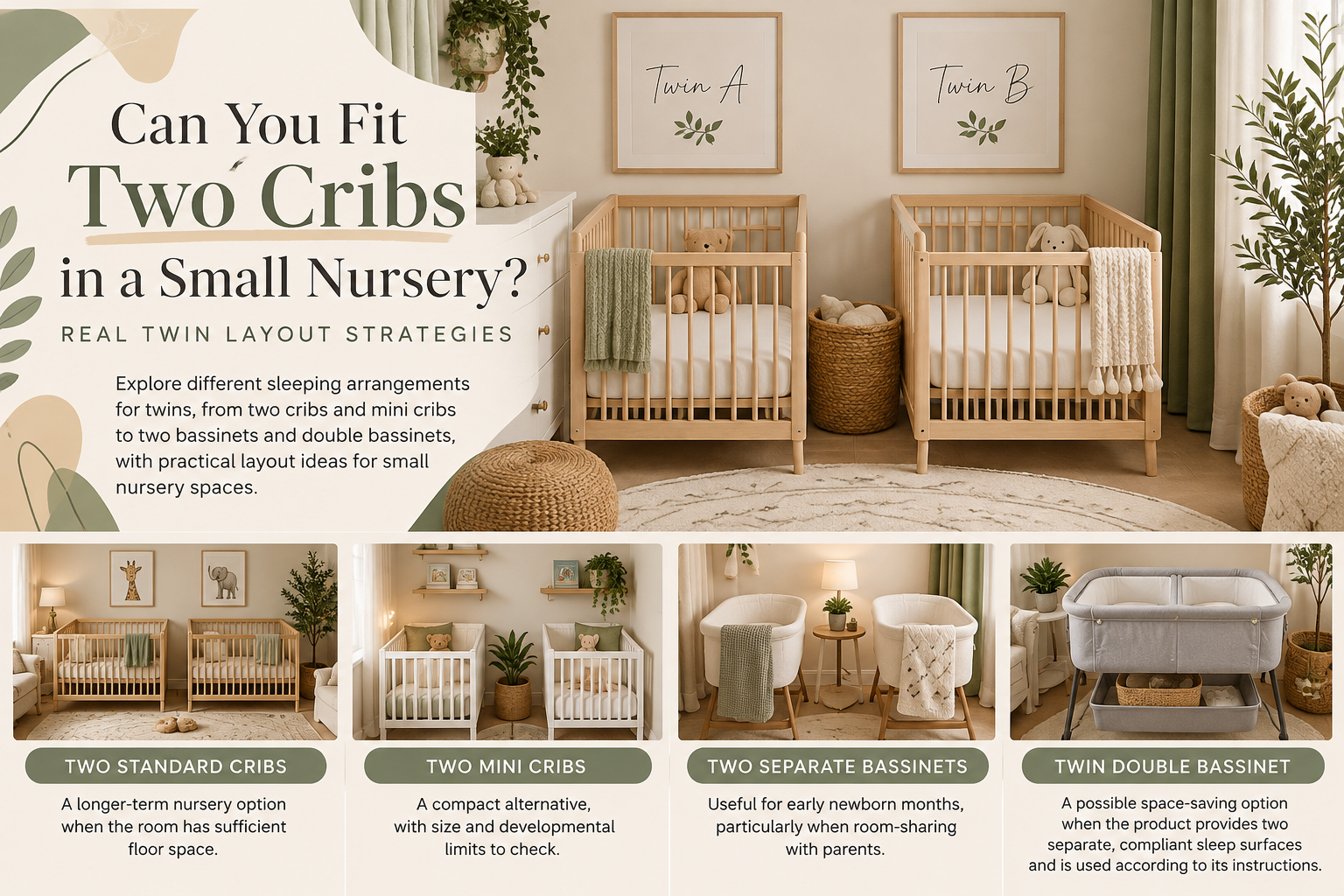
Each twin needs their own safe sleep surface, such as a crib, bassinet, or play yard that meets applicable safety standards.
For sleep, place each baby on their back on a firm, flat mattress with a fitted sheet. Keep pillows, blankets, stuffed animals, bumpers, and other soft items out of the sleep spaces.
The American Academy of Pediatrics recommends room-sharing without bedsharing for at least the first six months. If your twins initially sleep in bassinets in your bedroom, you can still plan their nursery for the transition to separate cribs.
Twin nursery tip: Don’t assume two standard cribs are your only option. Measure compact crib models as well, checking their safety certifications, manufacturer requirements, and recommended age and size limits.
The Bedside Sleep Check: Most twin parents keep their newborns in the master bedrooms for the first few months to survive midnight cluster feedings. Before buying bulky sleep sleep gear, you need to measure the clearance between your side of the bed and the bedroom wall.
2. Try a Side-by-Side Crib Layout
One of the simplest arrangements is placing both cribs along the same wall.
This creates a balanced, organized look and leaves other walls available for storage.
Why it works
Keeps both sleep spaces in one designated area.
Makes the nursery feel visually organized.
Can leave the opposite wall available for a dresser or changing station.
Works especially well in rectangular rooms with a long, uninterrupted wall.
What to consider
Measure the full width of both cribs and any space needed between them. Make sure you can reach each baby comfortably and that the cribs are away from window-covering cords, electrical cords, and furniture or objects babies could reach.
Best for: Rectangular nurseries with one long wall.
3. Consider an L-Shaped Twin Crib Layout
If your room doesn’t have one wall long enough for two cribs, an L-shaped arrangement may be worth exploring.
Position one crib along one wall and the second along an adjoining wall.
This can help use a corner that might otherwise go unused.
Why it works
An L-shaped layout can free up the center of the nursery and provide more flexibility for placing a dresser, glider, or storage unit.
Just remember that crib placement must still allow safe access and adequate clearance. Avoid positioning cribs near cords, windows, or objects that could be pulled into the sleep area.
Best for: Square nurseries or rooms with shorter wall sections.
4. Use Opposite Walls in a Narrow Nursery
For a longer, narrow room, placing the cribs on opposite walls may be more practical than putting them side by side.
This arrangement can create a central walkway and make each crib easier to approach, depending on the room’s dimensions.
Before committing, check whether the space between the cribs is wide enough for comfortable movement, opening drawers, and accessing the doorway.
Best for: Long, narrow rooms where side-by-side placement doesn’t fit.
5. Choose Furniture That Does Double Duty
When you’re designing a small twin nursery, every furniture purchase should have a purpose.
Instead of buying a separate changing table and dresser, consider using a sturdy dresser with a compatible, properly secured changing setup that follows the manufacturer’s instructions.
Look for furniture that helps you combine storage and daily care routines without overcrowding the room.
Some practical options include:
A dresser that also supports a safe changing setup.
Wall-mounted shelves for items stored well out of babies’ reach.
Drawer dividers for separating Twin A and Twin B’s clothing.
A compact feeding chair, if the room allows.
Closed storage for diapers, wipes, and extra supplies.
Anchor dressers and other tip-prone furniture securely to the wall, following manufacturer instructions.
Small-space rule: Don’t buy furniture simply because it appears in a beautiful nursery photograph. Buy it because it fits your actual space and supports your routine.
6. Think Vertically Instead of Filling the Floor
In a small nursery, floor space is valuable.
Rather than adding another cabinet, use safe, accessible vertical storage where appropriate.
You might organize supplies in dresser drawers, place lightweight decorative items on securely installed shelves away from cribs or use closet organizers to separate each baby’s belongings.
Keep frequently used supplies within convenient reach of the caregiver, but never within reach of a baby in a crib.
The goal is to make your nursery easier to use, not simply to fit more items inside.
7. Plan Your Changing Station for Two Babies
Twins can mean twice the diaper changes, but that doesn’t mean you need two changing tables.
A single, well-organized changing station is usually a more practical use of space.
Create designated storage areas for each baby’s clothing and personal supplies, with shared diapers and wipes stored conveniently.
Always keep one hand on the baby during changes and never leave a baby unattended on an elevated changing surface.
Twin Life Picks tip: Labeling drawers or storage sections for Twin A and Twin B can help caregivers stay organized, especially during those early newborn weeks.
8. Measure Before You Buy — Then Test Your Layout
This is where thoughtful planning makes the biggest difference.
A crib may look compact in a product photograph but take up more space than expected once it’s inside your nursery.
Before purchasing furniture, measure:
The room’s length and width.
Doors and their swing paths.
Windows and any heating or cooling vents.
Closet doors and drawer clearance.
The exact dimensions of both cribs.
Any dresser, chair, or storage furniture you plan to include.
Then sketch your room and experiment with different arrangements.
Try a side-by-side layout. Test an L-shaped configuration. See whether opposite walls provide a better walkway.
You may discover that the layout you originally imagined isn’t the one that works best.
The Bedside Sleep Check: Most twin parents keep their newborns in the master bedrooms for the first few months to survive midnight cluster feedings. Before buying bulky sleep sleep gear, you need to measure the clearance between your side of the bed and the bedroom wall. Will you use two separate bedside bassinets, or do you have the 3.5 foot clearance needed for a specialized double twin bassinet?
A Helpful Tool for Planning Your Twins’ Nursery
That’s exactly why we created the Twin Life Picks Pregnancy & Prep: Twin Triage Toolkit.
Our nursery planning resources include a printable floor plan grid, a furniture cutout kit, and a bonus interactive PowerPoint nursery planner that lets you drag and drop furniture elements while exploring possible arrangements.
Instead of guessing where everything might fit, you can start visualizing your options before making big purchases.
Explore the Twin Triage Toolkit on Etsy: Twin Pregnancy Planner Bundle | Registry, Nursery, Hospital Prep (digital Download-printable Fillable PDF)
The planning tools help you explore arrangements; they do not replace checking real furniture measurements, safe clearances, or manufacturer instructions.
9. Keep the Nursery Calm, Not Crowded
A small nursery doesn’t need to feel cluttered.
Choose a simple color palette, limit unnecessary furniture, and allow the room to breathe.
Warm ivory, soft sage, natural wood, and muted olive can create a welcoming, timeless space without overwhelming a smaller room.
You can also add personality through artwork, textiles used outside the cribs, and thoughtfully chosen accessories.
Remember, your twins don’t need a perfectly styled nursery.
They need safe places to sleep, a practical care setup, and a space that works for your family.
Frequently Asked Questions
Can twins share one crib?
For routine sleep, each twin should have a separate safe sleep surface. The American Academy of Pediatrics recommends against bed-sharing, including placing twins together on one sleep surface.
Are mini cribs a good choice for twins?
Mini cribs may help in smaller rooms, provided they meet applicable safety standards and are appropriate for each baby’s age, size, and development. Always follow the manufacturer’s specifications.
Do I need two changing tables for twins?
No. One properly equipped changing station can serve both babies.
What’s the best twin crib layout for a small nursery?
There isn’t one perfect arrangement. Side-by-side, L-shaped, and opposite-wall layouts can all be practical depending on the room’s dimensions, doorways, windows, and furniture sizes.
Should I buy cribs before measuring the nursery?
It’s better to measure first. Comparing actual furniture dimensions with your room measurements can help prevent costly purchasing mistakes.
Final Thoughts: A Small Nursery Can Still Make Room for Two
Designing a nursery for twins isn’t about having the biggest room or buying the most furniture.
It’s about creating a space that feels manageable, comfortable, and thoughtfully organized.
Start with safe sleep arrangements, measure carefully, choose versatile furniture, and experiment with layouts before committing.
And remember: a nursery designed with intention can be just as beautiful as one with twice the square footage.
Ready to plan your own twin nursery?
Explore the Pregnancy & Prep: Twin Triage Toolkit from Twin Life Picks, featuring registry planning, nursery layout tools, prenatal preparation, and hospital organization resources.
Shop the Twin Triage Toolkit on Etsy —Twin Pregnancy Planner Bundle | Registry, Nursery, Hospital Prep (digital Download-printable Fillable PDF)
Twice the Love. Thoughtfully Picked.
Safety note: Nursery layouts are illustrative planning ideas. Follow current safe sleep guidance, product instructions, and applicable furniture safety standards. Consult your pediatrician for advice specific to your babies.